

Presence
Really being there, with your body and your attention, before any words. Feeling what happens inside you while you meet the other person.
“I notice I lose touch with myself when…”
A set of practices and games for meeting people, and yourself, more truthfully. It started in San Francisco in the 1990s, out of Gestalt psychology, Nonviolent Communication, T-groups and Circling. We have been bringing it to Italy since 2019, with one extra rule: if you want to do it and it scares you, try doing it as a game.

We have more contacts than ever and fewer real conversations. Nobody teaches us how to be in a relationship: we pick it up by chance, from how things were done at home. And it costs us, in the body too.
1 in 6
people in the world feel lonely.
World Health Organization, Commission on Social Connection, 2025
+26%
the risk of death for people who live with loneliness; +29% for those who live in isolation. It weighs as much as other well-known risk factors.
Holt-Lunstad et al., Perspectives on Psychological Science, 2015
2023
the year the U.S. Surgeon General declared loneliness a public health emergency.
U.S. Surgeon General, “Our Epidemic of Loneliness and Isolation”, 2023
They work in any setting and with anyone. They are simple to understand and take a lifetime to practise.
Start by accepting yourself and other people: every part of the experience, in body and mind, is welcome. Anxiety too, and boredom.
The assumptions we make about other people are almost always wrong and almost always invisible. Checking them opens things up; taking them as true shuts things down.
Saying what you feel, think and want, as it happens, without fear of being judged. Nothing else creates closeness as fast.
What you feel is yours. It is not the other person’s fault and it is not a fact about the world: it is your experience, and you can choose where to take it.
Healthy boundaries, respect for your own worth and for that of the person in front of you. Dignity and humility together: that is how someone who knows how to relate carries themselves.
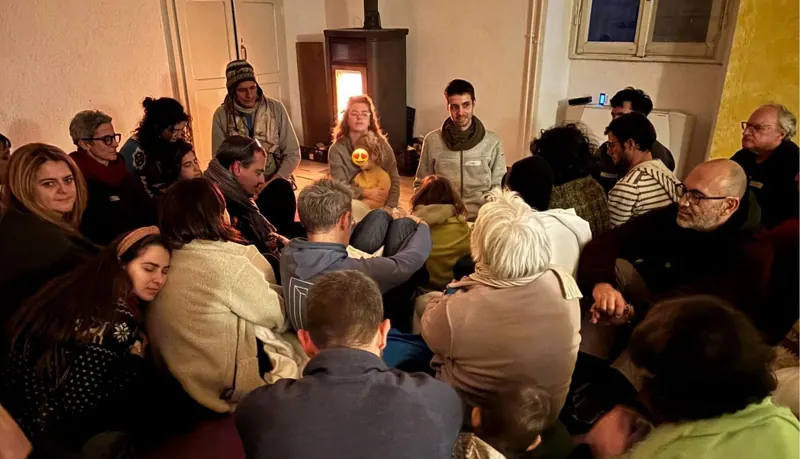
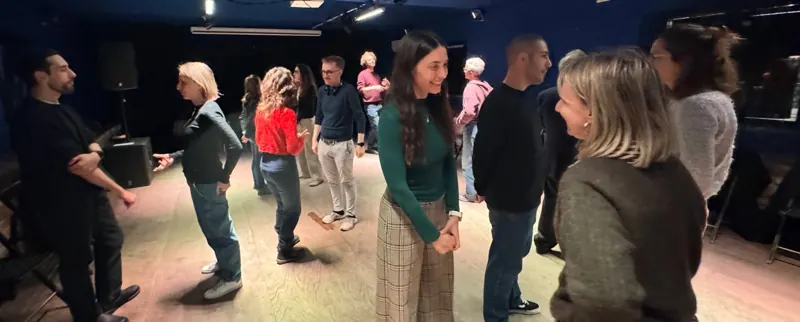
Really being there, with your body and your attention, before any words. Feeling what happens inside you while you meet the other person.
“I notice I lose touch with myself when…”
Listening without preparing your answer, without fixing, without judging. Saying back what you heard and checking you got it right.
“Did I get that right?”
Saying what you feel and think in the first person, with courage and without blaming. Revealing your own experience instead of describing other people’s.
“I feel… I need…”
Meeting the other person as if for the first time. Checking your assumptions instead of taking them for granted, and bringing out what hasn’t been said.
“What do you mean when you say…?”
Turning needs and wishes into clear requests, saying a no that doesn’t wound, negotiating, repairing after a rupture. Building the relationship together.
“I’d like to ask you… what do you think?”
Want to try them? Come to an evening: the first one is free.
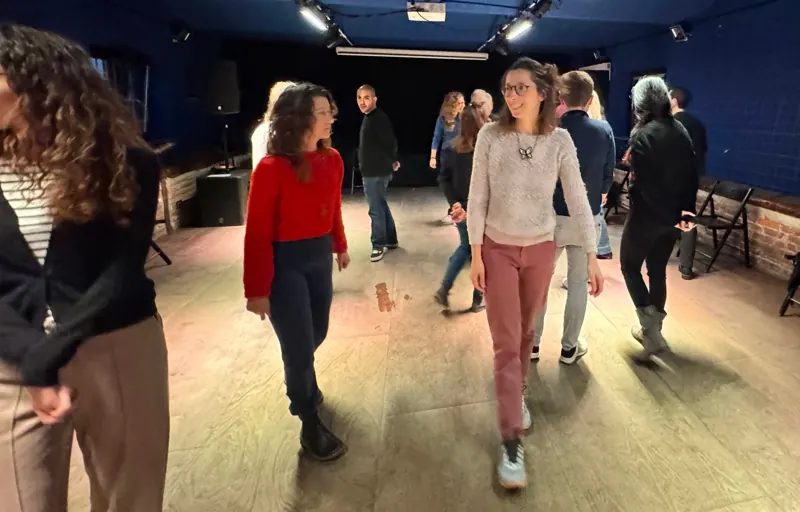
Play is a powerful way to learn for adults too: it increases creativity, learning and emotional resilience.
🔬 Stuart Brown, 2009
A lack of play weighs on mental health and social skills: without play, relationships lose spontaneity and lightness.
🔬 Peter Gray, 2013
High-quality listening lowers the speaker’s defences and improves the relationship; paraphrasing makes people feel more understood.
🔬 Itzchakov & Kluger, 2018 · Weger et al., 2014
Opening up gradually, when both people do it, creates closeness in a surprisingly short time.
🔬 Aron et al., 1997
All the sources we use, with the limits of each tool, are on the Method and evidence page of the app. Method and evidence →
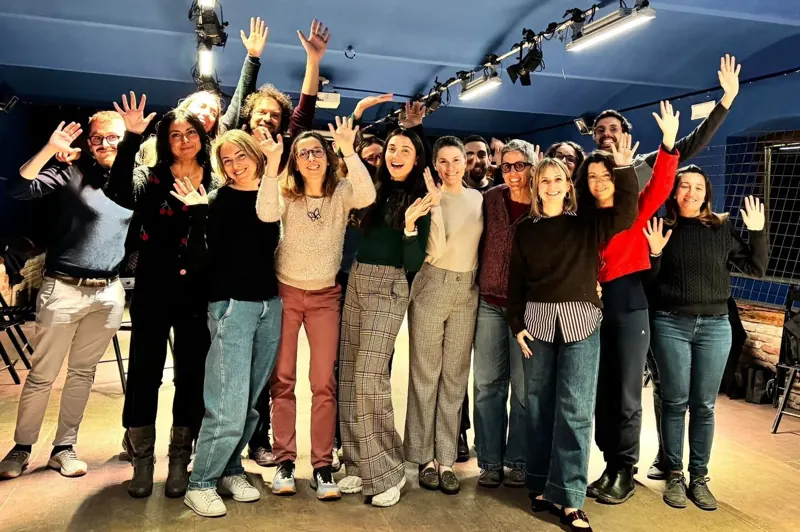
You explore emotions, limits and wishes in a welcoming setting, and find out how others see you.
You learn to put yourself in someone else’s shoes without losing your own.
Active listening, mirroring, questions that open things up: you use them the next day, with anyone.
Close relationships predict a long and happy life better than social class, IQ and genes.
Harvard Study of Adult Development · Waldinger & Schulz, 2023
Even short conversations with people you barely know improve your mood and your sense of belonging that day.
Sandstrom & Dunn, Personality and Social Psychology Bulletin, 2014
Opening up to each other, one step at a time, creates closeness quickly, even between strangers.
Aron et al., 1997
Wellbeing spreads through networks of people: if someone close to you is doing well, you are more likely to be doing well, up to three degrees of separation.
Fowler & Christakis, BMJ, 2008
When someone feels really listened to, they lower their defences, think less rigidly and open up to other points of view.
Itzchakov & Kluger, 2018
In teams, feeling safe to say what you think is what sets apart the groups that learn and work better.
Edmondson, Administrative Science Quarterly, 1999